 By smartcubs
 The grinder you use can make a major difference to the quality of your espresso. While blade grinders and burr grinders are both used to grind coffee beans, they produce very different results.
Blade grinders are usually cheaper and simpler, but they tend to create an uneven mixture of fine and coarse coffee particles. Burr grinders crush the beans between two grinding surfaces and generally produce a more consistent grind.
For espresso, grind consistency is especially important because espresso uses finely ground coffee and a relatively short extraction time.
Blade Grinder vs Burr Grinder: Quick Comparison
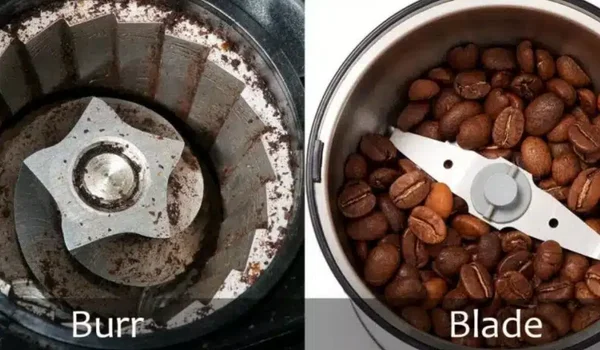
| Feature | Blade Grinder | Burr Grinder |
| Grinding method | Chops beans with a spinning blade | Crushes beans between burrs |
| Grind consistency | Low to moderate | High |
| Espresso suitability | Poor | Excellent |
| Price | Usually cheaper | Usually more expensive |
| Grind adjustment | Limited | Multiple settings |
| Control | Less precise | Much more precise |
| Heat generation | Can be higher with prolonged use | Usually easier to control |
| Best For | Basic coffee brewing | Espresso and specialty coffee |
How Does A Blade Grinder Work?
A blade grinder uses a small spinning blade to chop coffee beans.
The longer you run it, the finer the coffee generally becomes. However, the beans do not necessarily break down evenly.
Some particles may become very fine while others remain relatively large.
This inconsistency can be a problem when making espresso because water passes through different-sized particles at different speeds.
Advantages Of Blade Grinders
- Usually affordable
- Simple to operate
- Compact
- Easy to find
- Can work for basic coffee preparation
Disadvantages Of Blade Grinders
- Uneven grind size
- Limited control
- Difficult to produce consistent espresso grounds
- Longer grinding can generate heat
- Requires more guesswork
A blade grinder can be useful for occasional coffee drinkers, but it is generally not the best tool for serious espresso preparation.
How Does A Burr Grinder Work?
A burr grinder uses two burrs to crush coffee beans into smaller particles.
The distance between the burrs can usually be adjusted, allowing you to control the grind size.
This makes it much easier to produce the fine and consistent grounds needed for espresso.
Burr grinders come in different designs, including conical and flat burr grinders. Both can produce excellent coffee when properly designed and adjusted.
Why Grind Consistency Matters For Espresso
Espresso is particularly sensitive to grind size.
When coffee particles are reasonably consistent, water can pass through the coffee more evenly during extraction.
With a highly uneven grind, very fine particles can extract quickly while larger particles extract more slowly.
This can contribute to an espresso that tastes:
- Bitter
- Sour
- Weak
- Unbalanced
- Harsh
A consistent grind gives you more control when adjusting your espresso recipe.
Can You Make Espresso With A Blade Grinder?
Technically, you can grind coffee beans with a blade grinder and attempt to use the grounds for espresso.
However, getting a consistent espresso grind is difficult.
You may spend considerable time adjusting your grinding technique, shaking the grinder, and trying different grinding durations, but the results are unlikely to be as predictable as those from a good burr grinder.
If you regularly make espresso, investing in a burr grinder is usually a much better choice.
Burr Grinder Advantages For Espresso
A burr grinder offers several benefits:
Better Grind Consistency
The coffee particles are generally more uniform.
More Precise Adjustments
You can change the grind size to match your espresso machine, coffee beans, and recipe.
Better Control Over Extraction
Small grind adjustments can help you control how quickly water flows through the coffee.
More Repeatable Results
Once you find a setting that works, you can reproduce it more easily.
What Grind Size Is Best For Espresso?
Espresso generally requires a fine grind, but there is no universal setting that works for every bean or machine.
If the coffee flows too quickly, you may need to grind finer.
If the flow is too slow, grinding slightly coarser may help.
Other factors also affect extraction, including:
- Coffee dose
- Tamping
- Basket design
- Water temperature
- Pressure
- Coffee freshness
- Bean type and roast level
This is another reason why an adjustable burr grinder is useful.
Conical vs Flat Burr Grinders
If you decide to buy a burr grinder, you may come across two common designs.
Conical burrs use cone-shaped grinding surfaces and are common in both home and commercial grinders.
Flat burrs use two flat grinding discs and are also widely used in espresso grinders.
Neither design automatically guarantees better espresso. Burr quality, alignment, adjustment range, motor performance, and overall grinder design all matter.
Blade Grinder vs Burr Grinder: Which Should You Choose?
Choose a blade grinder if:
- You have a very limited budget.
- You make coffee occasionally.
- Espresso consistency is not a major concern.
- You primarily use simpler brewing methods.
Choose a burr grinder if:
- You regularly make espresso.
- You want more control over extraction.
- You care about grind consistency.
- You want repeatable results.
- You plan to experiment with different coffee beans.
Common Grinder Mistakes
Grinding For Too Long
With a blade grinder, continuously running the motor can increase heat and produce a mixture of particle sizes.
Using The Same Setting For Every Bean
Different beans can require different grind settings.
Ignoring Freshness
Freshly roasted beans and properly stored coffee generally give you a better starting point than stale beans.
Changing Too Many Variables At Once
When dialing in espresso, change one factor at a time when possible. This makes it easier to understand what improved or hurt the extraction.
Final Thoughts
For espresso, a burr grinder is the clear choice over a blade grinder. Blade grinders can produce usable coffee grounds, but their inconsistent particle size makes precise espresso extraction difficult.
A burr grinder gives you better consistency, greater control, and more repeatable results. You do not necessarily need the most expensive grinder available, but choosing a well-built burr grinder with useful grind adjustments can make a noticeable difference in your espresso routine.